Ask around when FSA money expires and the usual answer is December 31. Sometimes that is right. Just as often the plan year ends in June, or a grace period runs into March, or a carryover rolls a capped amount forward, or the claims window closes weeks after the money itself stops being spendable. All of those are real, all of them vary by plan, and none of them is something an app can know on your behalf.
Three dates, not one
An FSA year usually has more than one edge. The plan year end is the last day an expense can happen and still count against this year's money. If your plan offers a grace period, that edge moves out by a couple of months. Separately, most plans set a run out date, the last day you can send in a claim for an expense that already happened inside the year.
Three dates. Plan year end, grace period end if there is one, run out date. The first two decide when you can spend. The third decides when you can ask.
Grace period, carryover, or neither
Plans get to choose, within federal rules, how to soften the year end. A grace period gives you extra time to have expenses. A carryover lets a limited amount of unused money roll into the next plan year. A plan can offer one of those, not both, and some offer neither, in which case the year end really is the end. Whatever is left after the last date generally goes back to the plan.
The point is not to memorize which your plan does. The point is that you cannot guess. Two people at the same kitchen table can have two different answers, because they have two different employers.
The run out period is the one people miss
Even households that know their plan year end tend to blank on the run out date. It is the quieter deadline. Nothing changes at the pharmacy. The card still worked in December. The only thing that happens is that a claim sent in April for a cleaning in November is too late, and the money for it is gone.
Because it is quiet, it is the date most worth writing down. Put it on the same line as the plan year end, because that is where you will look for it.
The money can be spent by December and the paperwork can still be due in March.
Where the dates actually live
Your plan's summary plan description has them, usually near the words "plan year", "grace period", "carryover" and "run out". So does the benefits portal, in the plan details for the FSA rather than on the front page. Your HR or benefits contact can read them to you in one call. If you got a welcome letter when you enrolled, it is probably in there too.
Look once, write them down once. It takes ten minutes, most of which is finding the document. If you and a partner each have an FSA, do it twice, because the two plans will not agree; Brainbrook lets a household add a second account of either type and give it a name, so each set of dates sits under the right tag.
Enter them once
This is the part Brainbrook does. On the Deadlines screen you enter the dates that apply to you, with a label in your own words, and Brainbrook reminds you of them: 30 days before, 7 days before and on the day, by email, and by text if you have joined the SMS list. It never invents a date. The screen says so in its first line: Brainbrook reminds you only of dates you enter. Check your plan documents for the dates that apply to you.
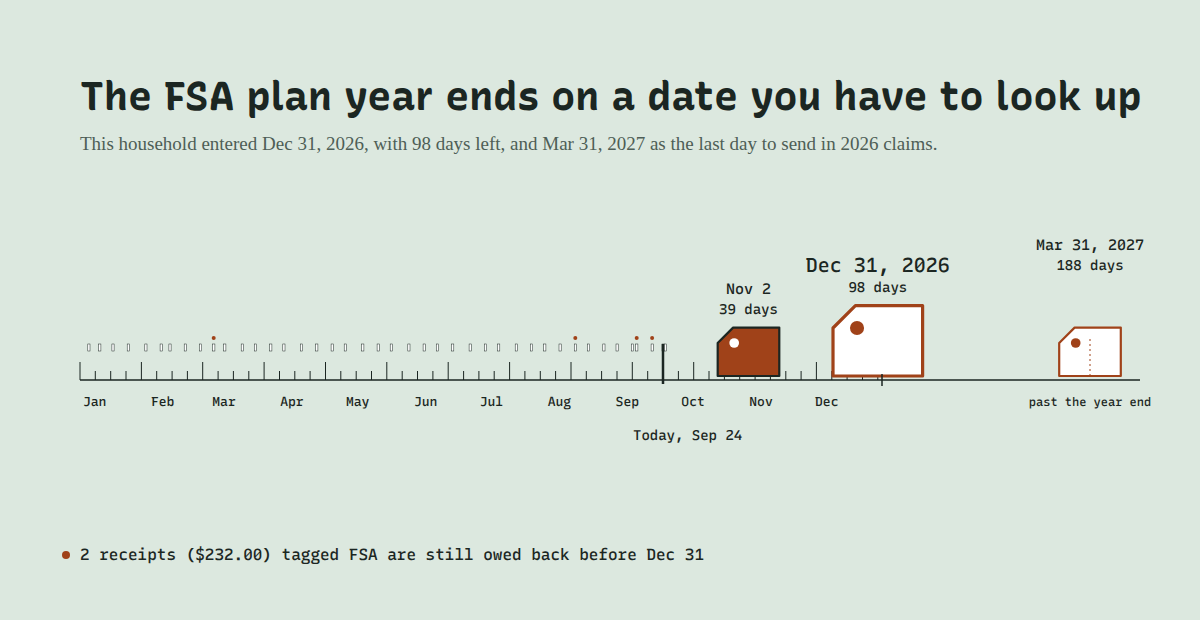
One tick per day, Jan 1 to Dec 31, 2026. A paper mark on each day a receipt was kept, a copper dot where it is still owed back, today's tick in ink, and a standing tag on each date you entered.
In the sample ledger the household entered three. Nov 2, 2026, open enrollment starts. Dec 31, 2026, FSA plan year ends. Mar 31, 2027, the last day to send in 2026 FSA claims. Each one stands on the year rule with its day count, and the plan year end carries a sub line that does the real work: two receipts, $232.00, tagged FSA are still owed back.
Dates you entered
Nov 2, 2026 Open enrollment starts39 days away
Dec 31, 2026 FSA plan year ends98 days away
2 receipts ($232.00) tagged FSA are still owed back.
Mar 31, 2027 Last day to send in 2026 FSA claims188 days away
HSA No deadline entered. Receipts tagged HSA stay owed back until you mark them reimbursed.
That sub line is the whole reason to keep receipts on the same screen as the dates. A deadline on its own is only a date. A deadline next to $232.00 you have not claimed yet is a Tuesday evening's task, and the reminder arrives with the number in it.
The HSA card says nothing, on purpose
Under the three dates there is a card for the HSA with no deadline at all: receipts tagged HSA stay owed back until you mark them reimbursed. That is not an omission. An HSA has no plan year end to race, so the calm is the correct display. The FSA is the one with a date, and now the date is in one place.